
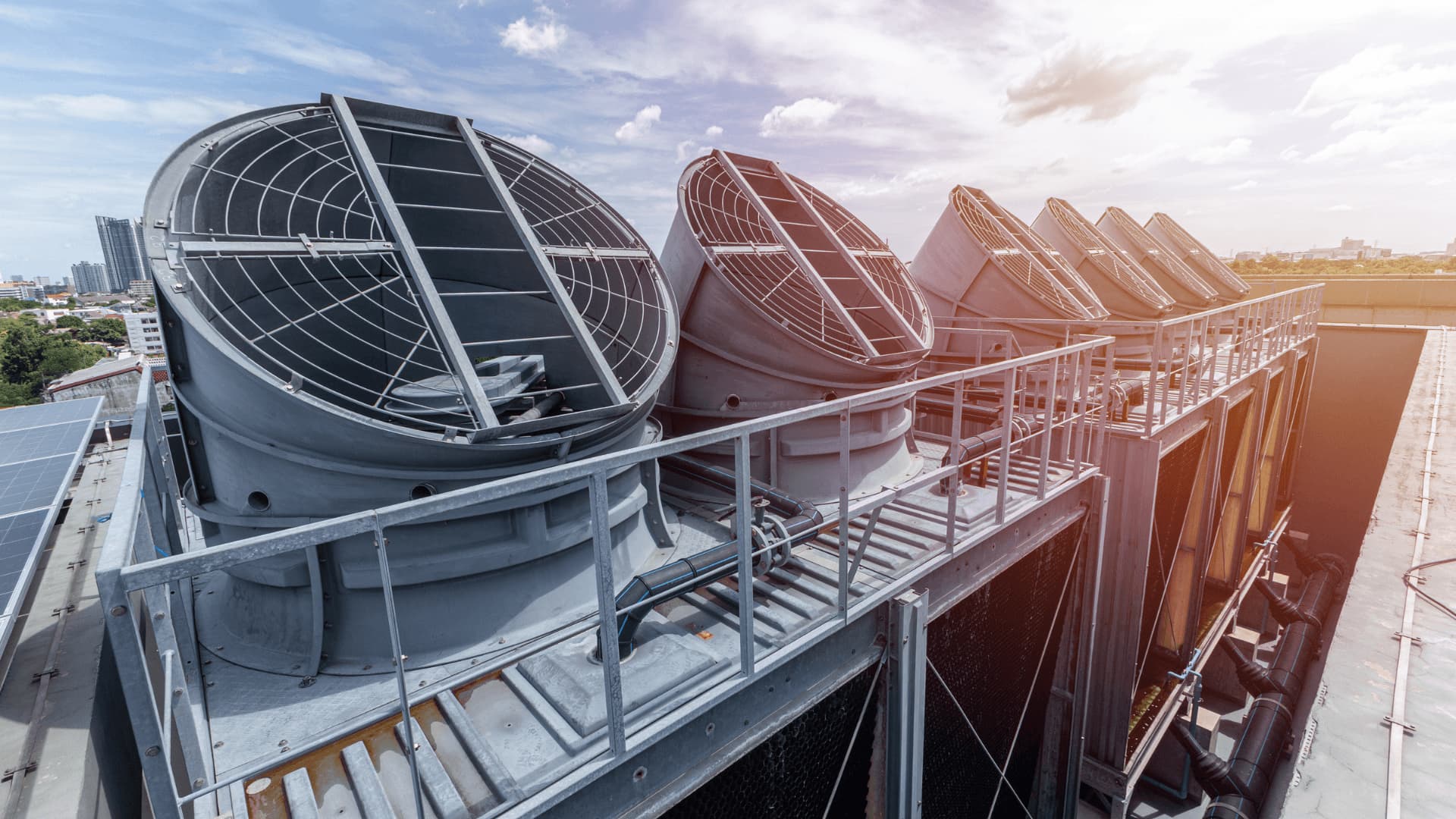
At an industrial site, the cooling system rarely gets any attention. As long as it maintains the right temperature, no one touches it. Yet that’s often where energy slips away silently, because the water carries far more debris than one might think.
What Cooling Water Really Carries
A cooling tower circulates vast volumes of air. Along with this air come dust, pollen, leaves, and insects. Make-up water, whether from a river or a well, brings its own share of sand and silt. In an industrial site’s water system, the pipes themselves begin to release rust and fine metal particles. In a plastics manufacturing plant, plastic residues are also present. And as soon as heat and light come into play, algae and biofilm begin to form.
All of this circulates in a loop. Nothing leaves the system, so everything accumulates until it settles where the flow slows down: in the heat exchangers.
How Fouling Reduces Efficiency
An insulating layer where heat transfer is needed
A heat exchanger—whether plate or tubular—operates on a simple principle: heat must transfer as easily as possible from one fluid to another through a metal wall. As soon as a deposit forms on this wall, it acts as an insulator. Deposits such as scale or sludge conduct heat more than twenty times less efficiently than steel. A film just a few tenths of a millimeter thick is enough to make a significant difference.
In plate heat exchangers, the problem is even more pronounced. The channels are narrow—sometimes only a few millimeters wide. Particles get trapped there, narrowing the passage and creating areas where water stagnates.
A Chain Reaction of Losses
The first effect is seen in the temperatures: the water comes out less cold, or the process cools less effectively. To compensate, the system has to work harder. Here’s what we most often observe:
- pumps working harder to compensate for the increased pressure drop
- cooling tower fans running longer
- chillers or compressors consuming more energy to maintain the setpoint
- more frequent shutdowns to disassemble and clean heat exchangers
Depending on the condition of the system, the difference in energy consumption ranges from a few percent to significantly more. Add to this the corrosion that develops beneath the deposits and the bacteria that thrive there: fouling damages equipment just as much as it costs in energy.
Chemicals alone do not solve the problem
Faced with this, many sites rely on chemical treatment: biocides, dispersants, and corrosion inhibitors. These products have their uses, especially against microorganisms, and cooling towers are, in fact, highly regulated in France due to the risk of Legionella. But they do not remove solid particles. They are expensive, require regular monitoring, and ultimately end up in the drain water.
The cleaner the water, the fewer reagents are needed. Removing particles upstream, therefore, addresses the cause rather than the symptoms.
Automatic Filtration: A Preventive Approach
The idea is to capture particles before they have time to settle. The word “automatic” is key here. A cartridge or bag filter becomes clogged, requiring someone to replace it—and in the meantime, the flow rate drops. A self-cleaning filter, on the other hand, clears itself without shutting down the system and without using consumables.
Another useful point: it’s not necessary to filter the entire flow. You can use a bypass system—that is, divert a portion of the water, filter it continuously, and return it to the loop. Since the water is constantly circulating, the entire system regularly passes through the filter. This reduces the size of the equipment and the initial investment.
What Hectron Filters Offer
Hectron has been manufacturing self-cleaning water filters in Nice since 2004. Two product lines are available for industrial systems. The AG series handles flow rates up to 340 m³/h and operating pressures up to 16 bar. The AS series is designed for low-pressure systems. In both cases, backwashing is fully automatic, and no replacement parts are needed.
Unlike a magnetic filter, which captures only ferrous particles, these filters also trap non-metallic dust, plastic residues, and plant debris. Furthermore, this filtration helps reduce the need for chemical water treatment.
In practice, this is demonstrated, for example, at a steel wire drawing plant in Haute-Saône, where a 20 µm AG300 filter treats 60 m³/h drawn from a 350–400 m³/h system to inhibit the growth of microorganisms in the piping. Another example: a steel mill in Algeria, with a low-pressure system and a need for fine filtration, equipped with two 6-µm AS400 filters.
Where to Start
Before discussing equipment, a few measurements are all it takes to assess the current situation: the temperature difference between the inlet and outlet of your heat exchangers, the pressure drop across them, the frequency of cleanings, and the appearance of the water you find each time you open the unit. An analysis of particle size then helps determine the filtration threshold, ranging from a few microns to several hundred, depending on the situation.
If your heat exchangers are fouling up faster than expected or if your energy bill is rising for no apparent reason, the Hectron team can help you design a filtration system tailored to your network.


