
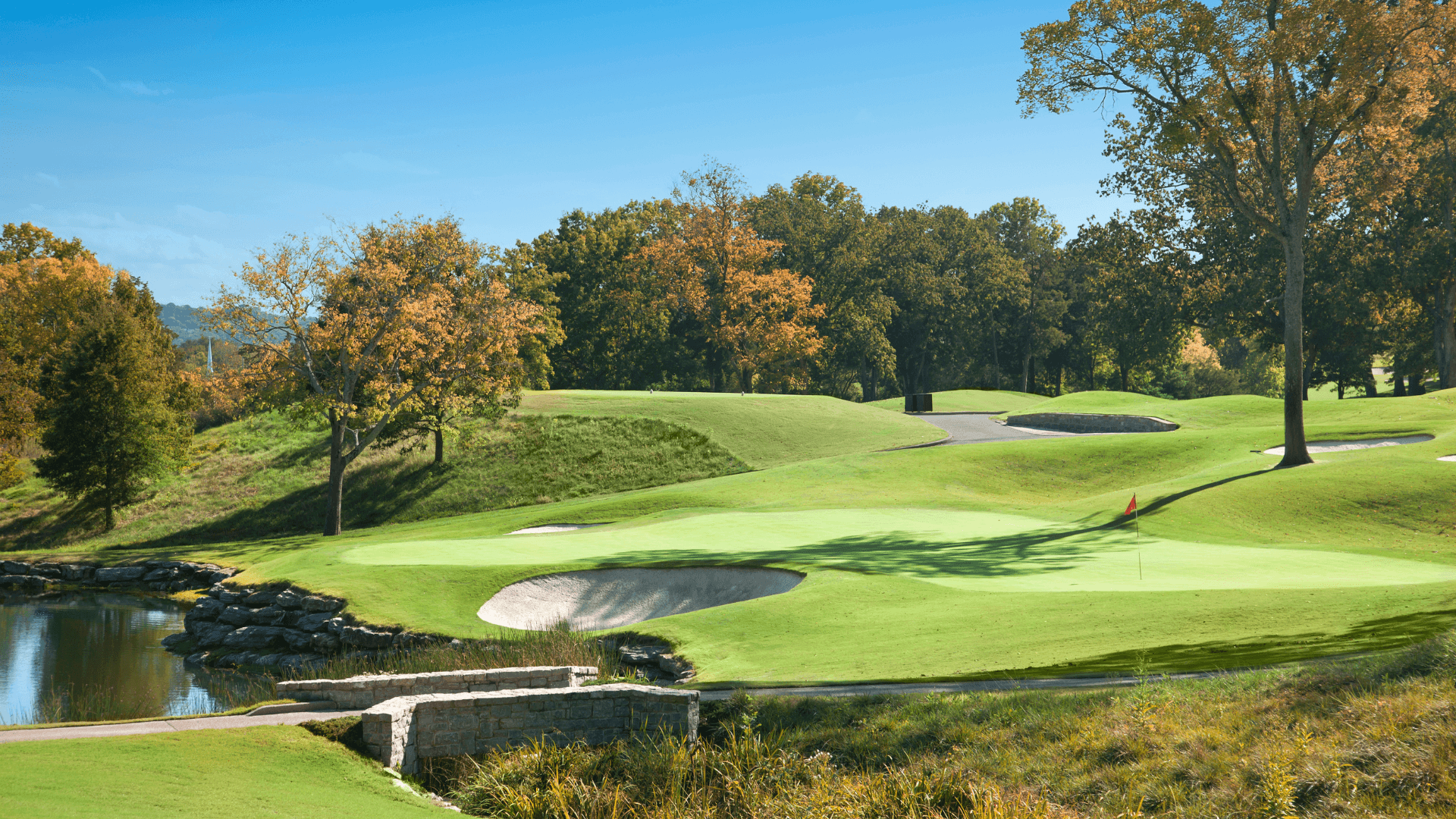
A flawless green, fairways that remain uniformly green in the height of summer, and municipal gardens that withstand the heat without any signs of water stress: behind these results lies an irrigation system that often runs for several hours a night, without anyone noticing. Until the day a sprinkler becomes blocked, a solenoid valve stops responding, or an entire section remains dry for no apparent reason.
On that day, the maintenance teams find themselves digging, dismantling and replacing parts. On a 50-hectare golf course or in a densely planted urban park, the bill can quickly mount up. And the problem, very often, is not mechanical: it is the water itself that is at fault.
Water that is rarely as clean as it looks
Irrigation systems for golf courses and green spaces draw their water from a wide variety of sources: boreholes, hillside reservoirs, lakes, rivers, catchment basins, or even treated wastewater as part of water reuse schemes (REUT), which have been developing rapidly since the 2022 decree. Whatever the source, this water almost always carries suspended particles: silt, algae, fine sand and organic residues.
In a pressurised system, these particles travel to the most vulnerable points: sprinkler heads, nozzles, micro-sprinklers and solenoid valves. They gradually accumulate there. Flow rates decrease and coverage deteriorates. Sometimes, this results in a complete blockage. Sometimes, it is just a slight irregularity in distribution which, over time, leads to scorched patches or, conversely, waterlogged areas.
This clogging phenomenon is the number one enemy of golf course and green space managers. It is not dramatic, but it is constant, and it is expensive.
Clogging: a cost issue before it is a technical one
On a golf course, the irrigation system represents an investment of several hundred thousand euros. The sprinklers, solenoid valves and pipes are largely buried beneath the turf. Every repair job involves locating the fault, digging up the ground, cleaning or replacing the faulty part, then filling in the hole and restoring the disturbed turf.
The cost of a single repair job of this kind is rarely less than a few hundred euros, including labour, materials and site restoration. Multiply that by the number of annual incidents on a large golf course, and you can see why the issue of filtration quickly becomes a question of cost-effectiveness.
For local authorities managing parks, stadiums or green spaces, the reasoning is the same. Maintenance budgets are tight, and teams are small. Every hour spent unblocking a sprinkler is an hour taken away from other tasks. And external contractors charge for every call-out.
Installing effective filtration upstream of the network is therefore the right approach: prevention rather than cure, and spreading costs over time rather than facing unpredictable expenses.
Why conventional filters are not enough
Manual strainer filters or cartridge filters are still found on many sites. Their principle is simple: to trap particles before they enter the network. The problem is that they become clogged themselves, and must then be cleaned or the cartridges replaced.
On a golf course that irrigates every night, a cartridge filter can reach its saturation limit within a few days during periods of high turbidity: after rain, during an algal bloom in the storage lake, or simply in the height of summer. Without human intervention, the pressure drops, irrigation becomes insufficient, and the filter eventually allows the impurities it was supposed to trap to pass through.
Manual maintenance of a conventional filter is a regular chore: checking its condition, cleaning, and replacing consumables. These tasks pile up on installations that are often isolated, sometimes difficult to access, and where the ideal frequency is rarely adhered to in practice.
Hectron’s solution: self-cleaning filters
Hectron has been designing and manufacturing automatic water filters for over twenty years at its site in Nice. Its speciality: systems capable of self-cleaning without any human intervention, continuously, without interrupting the flow.
The principle is based on a metal screen coupled with a suction ramp. When the pressure differential between the filter’s inlet and outlet exceeds a predefined threshold (a sign that the screen is beginning to clog), an automatic cleaning cycle is triggered. The suction ramp cleans the screen from the inside, extracting the trapped particles and flushing them out. The operation takes a few seconds, requires only a small volume of water, and the system continues to operate normally throughout the process.
No cartridges to replace, no system shutdowns, no scheduled maintenance.
The AG range: versatile, robust, suitable for all flow rates
For golf courses and large irrigated areas, the AG range is the benchmark. These filters are available with filtration ratings ranging from 1 to 500 microns, allowing them to be adapted to the quality of the water available on site. For borehole water containing fine sand, a fine rating should be chosen. For lake water with large algae, a coarser rating is sufficient to effectively protect the sprinklers.
The range covers flow rates up to 340 m³/h, making it suitable for everything from a small municipal green space to an 18-hole golf course with several hundred sprinklers. The filter housings are made of welded stainless steel, designed to withstand intensive outdoor use.
A filtration rating of between 80 and 100 microns is generally recommended for protecting irrigation systems: fine enough to trap particles that could block sprinkler heads, without causing the filter itself to clog too frequently.
The Prago filter: the compact solution for small boreholes
For systems supplied by a low-flow borehole (typically small green spaces or golf course outlying areas), the Prago filter offers an economical and effective alternative. Designed for flow rates of up to 8 m³/h, it is 100% automatic, requires no consumables, and is particularly suited to removing sand from borehole water.
Alfa hydrocyclones: when sand is everywhere
At some sites, the sand content of the water is too high to be treated effectively by a screen filter alone. The Hectron hydrocyclones in the Alfa range separate heavy particles using centrifugal force, with no moving parts or consumables. They often form the first stage of a two-stage filtration process, preceding an AG filter which provides additional protection.
An investment that pays for itself over time
The question of initial cost always arises, and rightly so. An automatic filter represents a greater investment than a manual or cartridge filter. But the calculation changes as soon as operating costs over three or five years are factored in.
No consumables to replace, a drastic reduction in maintenance work on the irrigation network, and continuous operation even when water quality fluctuates: the savings generated over time more than offset the higher purchase cost.
For a golf course manager or local authority keen to control its expenditure, this represents an investment rather than an expense, with a measurable and predictable return.
Hectron supports its clients from the initial assessment of their system right through to selecting the appropriate equipment, taking into account the water source, the required flow rates and the specific constraints of each site. This ensures that the filtration system installed will not only be effective on the day of installation, but will remain so year after year, without anyone having to give it a second thought.


