
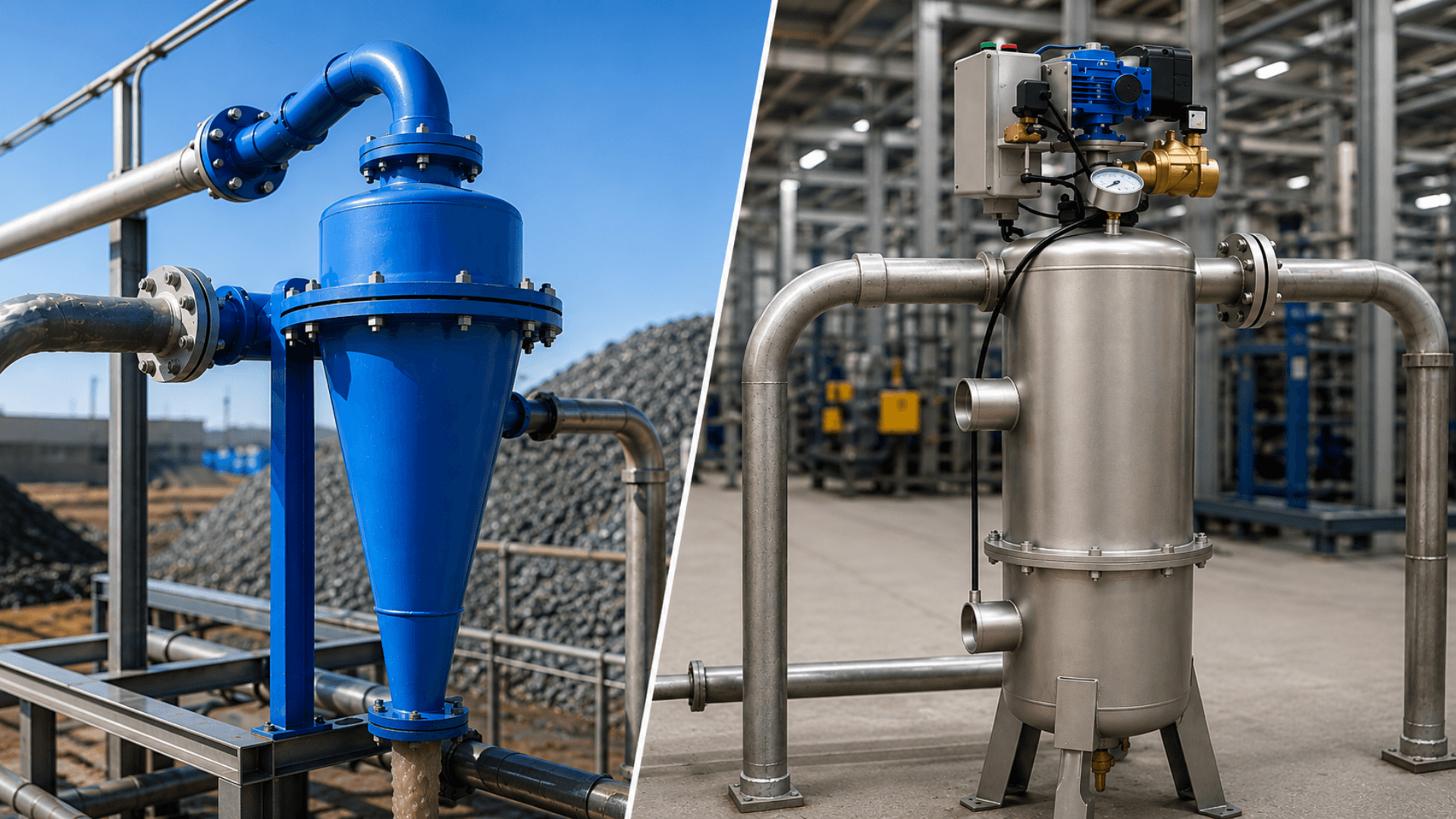
When filtering well water, industrial process water, or water for an irrigation system, the same question almost always comes up: hydrocyclones or self-cleaning screen filters? Both technologies have been around for decades, both have proven their worth, and yet we continue to see installations where the wrong choice was made from the start. The result is either more maintenance than expected or a filtration system that can’t handle the load.
In reality, it’s not so much a question of which technology is “better” as it is a question of suitability. A hydrocyclone and a screen filter do not operate in the same way, and, more importantly, they are not effective at removing the same types of particles. Let’s take a closer look.
Two Radically Different Operating Principles
A hydrocyclone is not a filter in the strict sense of the word. There is no screen, mesh, or membrane inside it. Water enters tangentially into a conical or cylindrical tank and begins to spin at high speed. This rotation creates a centrifugal force that flings the denser particles toward the walls, where they gradually slide toward the bottom of the tank before being drained. The clarified water, meanwhile, exits through the top. No moving parts, no motor: the process relies solely on the physics of water movement.
This is precisely what makes stainless steel hydrocyclones —such as the HN and HNC models—so effective: with no moving parts, there is virtually nothing to maintain and no wear parts to replace. Drainage is performed manually via a large-bore valve, which effectively removes deposits accumulated at the bottom of the tank.
The screen filter operates on an entirely different principle. Here, the water passes through a cylindrical screen whose mesh physically traps suspended particles larger than a certain size. When this screen begins to clog, a pressure switch detects the pressure difference between the filter’s inlet and outlet and automatically triggers a cleaning cycle: a rotating ramp either draws in or sprays water across the entire surface of the screen to dislodge the trapped particles, which are then discharged through a purge solenoid valve. This is the principle found in Hectron’s AG and AS series; the difference between the two lies in the cleaning method: backwashing by suction for one, and pressurized water spray for the other.
What really makes the difference: the nature of the particles
This is where the choice really comes down to, far more than flow rate or footprint. The two technologies do not respond the same way depending on what they are required to retain.
Sand and dense particles, typical of drilling or well water, are the hydrocyclone’s natural domain. The denser a particle is, the more easily it is flung toward the wall by centrifugal force. A properly sized hydrocyclone effectively retains sand as small as about 100 microns, without ever clogging, since there are no mesh screens to become blocked. In fact, this solution is often used upstream of a plate heat exchanger to protect the system from sand-laden well water.
Fine sludge and less dense suspended solids, however, pose a problem forthe hydrocyclone: if a particle is too light relative to its size, centrifugal force is insufficient to effectively separate it from the water, and it is carried along with the clarified flow. This is typically the case with fine clay sludge or certain types of suspended organic matter. For this type of load, a self-cleaning screen filter has the advantage: the mesh retains particles regardless of their density, provided they are larger than the selected filtration size.
Organic and fibrous materials (algae, plant debris, biofilm) are also better handled by a screen filter. These materials tend to form sticky deposits that do not slide easily down the walls of a hydrocyclone, whereas a screen, combined with a properly adjusted automatic cleaning cycle, removes them easily before they accumulate.
In many industrial facilities, the two technologies are not mutually exclusive; rather, they complement each other. An upstream hydrocyclone captures the coarsest sand-laden fraction, which significantly reduces the load reaching the screen filter located immediately downstream. As a result, filter wash cycles are spaced further apart, and the entire system becomes more reliable.
Maintenance, Consumption, and Operating Constraints
The hydrocyclone stands out for its mechanical simplicity. With no motor or solenoid valve, there is virtually no risk of failure related to electronics or moving parts. The trade-off is that drainage remains manual on the HN and HNC stainless steel models: therefore, regular maintenance must be scheduled, or the unit must be paired with an automated drainage system if the application requires it.
The self-cleaning screen filter, on the other hand, operates completely autonomously once installed. The pressure switch controls the cleaning cycle without human intervention, making it a particularly suitable solution for hard-to-reach sites or operators who wish to minimize maintenance visits. However, it consumes a small amount of water and energy with each cleaning cycle, and the screen, although robust, is still a mechanical part subject to wear and tear over the long term.
How to Decide
Before making a choice, it’s best to ask yourself three simple questions: What is the density of the particles to be treated? What is the flow rate to be filtered? And what level of autonomy are you looking for in the system? For well water containing sand, the hydrocyclone is often the best choice as a robust and economical solution. For water containing fine sludge, organic matter, or requiring fine, automated filtration, the screen filter is the better choice. And in many cases, the best solution is simply to combine the two, with each handling the portion of the load for which it performs best.
Each application has its own constraints regarding flow rate, particle size, and pressure, and improper sizing can significantly reduce the effectiveness of either technology. Please feel free to contact our team so we can work together to determine the solution best suited to your water and your system.


